
This article will be comparing precious metal and digital assets, to see how similar they are, despite being a different class of assets.
For this article we are predominantly ignoring a big part of contemporary investing in precious metals; the ability to buy a partial, sometimes complete, bar online and become its legal (part) owner. The reason behind this decision is that there still is a physical product at base of the transaction, it also can become a grey area depending on your point of view: The product is physical, but the buyer only has a digital proof of ownership. This form of ownership may well be the best of both worlds, it is cheaper and easier than handling a physical bar of metal.
Should be noted that this article was written in April 2026, so its view might be outdated as digital investments are becoming increasingly mainstream. At moment of writing there are big investment companies with ETFs and big mainstream banks offer cryptocurrency based products.
Description of both
Let us first define both asset classes, just to clarify what is being discussed.
Precious metals
These should not require an introduction; gold, silver, platinum group, copper, etc. This article uses it as a name for metals that are used as investments and potentially for payment; official country mints strike coins with these metals, the created coin is a legal tender within the country.
Digital assets
In theory, everything that is digital, can be considered a digital asset. Here we are more concerned with things that have- and add tradeable value. So something digital that can be considered an investment; buying and selling potential of the asset ought to be considered a prerequisite for sake of this article.
Cryptocurrency
In this writing, we are mostly using cryptocurrencies, though only a very small part of all things digital, they do make headlines and are considered both investments and means of payment, to a highly varying degree. Thereby meating the standard for a asset.
Other
Mostly media and other forms of content; think of a picture or some music, pretty much anything that exists digitally and is of value, so a document with vital information also counts. Non-fungible tokens are highly important for investments/ownership in media and such; they are used to certify ownership of a the underlying digital asset.
We also have other forms, that are highly comparable to cryptocurrency: Digital currencies used by banks and other financial institutions. These assets serve to make transactions, their value always has to be equal to something else, otherwise they lose all value, spelling short term doom for the thing they have to match in value. Though seemingly assets, they really only serve to make transactions, not to be bought/sold or stored by investors. It is even possible to earn interest from stablecoins.
Comparing
The biggest common trait is their store for value, albeit on a different timescale: Gold and silver have been investment grade, and money itself, genuine ages before the dawn of investment products, where digital assets can be mainly used to transfer value. Wealth can be stored in a digital asset, but the value fluctuates greatly, so you can lose everything in a short amount of time. Digital assets are considerably easier to transfer, as that happens electronically, where a bar of palladium has to physically change hands to become the true property of another.
Their other similarity is that their own value is based on scarcity and demand, far more so than practical value: A digital asset can sometimes be used to pay for things or store information, which is the limit of its field use. Though useful, it hardly warrants some of the fluctuations seen in both cryptocurrency and pictures sold as art. These factors also play a role in their shared exposure to news events, anything from disasters to interest rates can affect the prices of both asset classes.
A, partially applicable, parity is the use in coins; precious metals became important as coinage for trade. A few of the biggest cryptocurrencies have their code stored on a coin made of precious metals (usually silver). There is no reason to believe that the same cannot apply to jewellery, a cornerstone of gold and silver demand that is yet to be fully applied to digital assets. Currently the coin with code example serves as a way to combine the two, which seems like a nice combination for those that wish to diversify into one or the other, but do not wish to steer to far from their main asset.
Prerequisite for increased interdependence
As we discuss in 29 Primer on precious metals, precious metals can be exceedingly versatile, digital assets can also be used for pretty much everything that happens digitally: They are just completely different applications. There is a interlink allready established between these different worlds; digital assets require a large amount of precious metals to be build, this in turn increases the value for both as demand soars for metal, so do profits and prices from it, clearing the way for investment in other assets as the need to diversy becomes more urgent.
What we still need is for digital assets to become a full fledged asset class, easily available to all via ETFs, at a competitive fee. A part of what is needed for that is wide availability, a problem as scarcity drives value of some assets, but they can be supplemented with others; a positive as it decreases the risk associated with a heavy reliance on a single asset. Eventually creating a diversified portfolio of digital assets, much like how most metal sellers offer both platinum group and copper items. Hope for this is mildly in vain; very few ETF offer gold and silver in the exact same product, let alone adding corporate equity and bonds, they remain separate products for now.
A big problem is the easy by which new digital assets are created and marketed, anyone with digital knowhow can make and share them online. It is not inconceivable that AI will be able to create them soon, if not already. To become a as important as millennia old worshipped yellow metal, a central body (in theory for the entire human race) needs to be established to root out the conartists and skechty cowboys. Creating a big barrier for entry, resulting in a semi limited but trustworthy group of assets to chose from, would make any investment far less risky. New investors also need not fear losing all their money, at least less so then when buying online without any unbiased guidance. Should be noted that the goal of this suggestion is not to stiffle competition, but to remove those that seek nothing but short term profit, by exploiting the gullabiliti of some. As such, we do not intend for a central body to allow only the trading of an elite few, instead it should allow newcommers when they have a well build case for their added value. The cost of applying should not exceed total cost made by those testing and approving!
Closing notes
Here we have a chart with the changes during that month for two of the most popular precious metals and digital assets; Gold and silver, versus Bitcoin and Ethereum, over the course of 2025. Should be noted that december was left out, because digital assets are traded around the clock, while precious metals are only traded during business hours. This gave an unfair advantage to the cryptos as December ends in a week long holiday, during which professional traders (who are more active in metal than crypto) work far less than hobbyist (who can favour crypto).
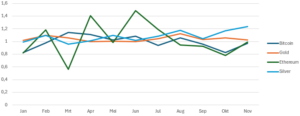
As you can see, the movements are not that far apart, with exception of Ethereum, which is a smaller cousin of Bitcoin, therefor it can be more volatile.
Earlier we have a section dedicated to the two asset classes getting closer together, this might be good idea at the cost of diversification. Having a physical option (precious metals) and a non physical counterpart (digital assets), allows for less exposure to certain types of risk and more exposure to other factors. As is the case with all investments, it is vital to do your own research.