
Here we take a look at why debt can increase, despite best efforts, and how to prevent this.
Debt trap
Once you get into debt, it becomes increasingly difficult to get out of it, for which there are many reasons; not in the least unpaid bills pilling up. Also, those more sensitive to social pressure, can feel like missing out or are persuaded to undertake optional activities; so you get into more debt.
Based on law
Your correspondent was once on welfare, which wasn`t a problem financially (always adapt your spending to your income), but it did mean that no institution was willing/able to lend him any money. Despite having surplus savings and even investments with those institutions*. This was enacted to prevent the poor from falling into a debt trap, but actually denies a group the ability to properly manage their finances. Thereby factually trapping them into pre-existing conditions, with little means of escape. For instance, the ability to get a loan at better rates (potentially extending one when needed), or escape paying rent by purchasing a piece of property. Virtually all expenses have to be saved for, which is not bad since saving can turn a profit or receive interest, it just means that you are not able to make all the beneficial decisions, that a situation might give rise to.
Besides the above, we also have maximum/minimum- rates and amounts that can be borrowed based on income and collateral. These actually might be beneficial, as it makes sure that you cannot borrow far more than can be afforded, or how much what you have is worth. Should be noted that these are partially created for the protection of the capital provider; lending more than an collateral is worth, is not really a bad thing for the capital receiver, as it constitutes selling the asset at a profit. The maximum based on income also protects the banks and such from high default rates, where the lendee can look at his budget and see whether or not the monthly payments are indeed manageable.
Based on behaviour
There are two general ways of becoming indebted: 1 By circumstances which are beyond your control, you were not spending excessively on frivolous matters, but found yourself quite a bit of cash short anyhow. 2 Fully because of your own indiscretion, money was spent that did not have to be spent, and then a huge amount of money was spent as well.
If you are part of the first group, no reason to panic, just adjust to the situation and plan ahead; all should be well in time. The second group needs to change its behaviour, otherwise debt just keeps expanding. This requires a significant change in attitude, outside intervention is not unheard of.
Banking accounts that allow an overdraft (spending more than you have on it, e.g. a negative balance on the part that payments are made from), is generally the absolute worst you can do with finance: It allows you to spend money that you might not have, whilst generally charging the highest interest percentage available. Other short terms loans also tend to demand high rates, so long stable loans are the preferred option. Though that requires an behaviour adjustment: Planning for many small expenditures with a big loan. instead of using quick credit options.
Buy now pay later
Before using this, always figure out how you are going to pay for it, and if it is considered debt in the eyes of the law: Buying on normal credit (usually an invoice to be paid within 30 days) is normal, but paying well over a thousand bucks in three separate instalments, spanning over two months, is something different; this may be considered a debt.
Keep in mind that every form of credit is paid for in one way or another. Using credit cards is generally a bad idea, as they charge interest, using a platform that does not charge you, likely charges your supplier, so could be useful if managed properly.
When is it relevant
It is mostly useful for when you know that a sufficient amount of cash is coming in, just not soon enough to make a purchase when you really need it, but well before the payment deadline of when you buy the widget on credit.
How to manage properly
You need to actively trace all your accounts. Focusing on how much is owed and when it is due. Just make a list with as much detail as you consider useful (besides amounts and dates), and add how you are planning to settle each account. Or only use it sporadically, so you only have to keep the emails and/or a note in your to-do-list.
General rules
- The absolute first step is investigate when something is considered debt for your local variant of credit score: When does something purchased on credit become relevant for how much you can borrow, what interest you pay, etc.
- Make your budget, for which we have several articles and such on Opinion Economics, even tighter than it was; build in a nice amount of savings, so you can maybe repay a bit earlier, or prevent becoming dependent on others. This is when you stop playing nice with fixed expenses and reconsider every little recurring cash outflow, non-recurring ones should seize immediately.
- If there are people in your immediate circle who fail to understand your financial situation, maybe reduce contact with them. Colleagues who constantly propose group activities are to be avoided anyhow; work is for getting money, not spending it!
- In this article we mention that getting a loan may be cheaper then selling assets, that only applies to when you are fully in control of the situation. This may not apply to everyone and selling assets is always something that should be considered a priori to getting a loan.
- Avoid minimum payments, simply pay the full amount, if possible, upfront; this avoids having to spend money at a later date, whilst you forget about it in the mean time. Always paying for everything means that you do not have to pay any interest, or only the bare minimum, over a single period (generally one month, so 1/12 of the stated annual amount).
- Start by paying of the highest interest case. Thereby reducing your cost of capital and removing a big money drain.
- See if there are free local counsellors or others forms of aid available. Most cities offer some service, otherwise there usually are non-profits. These might be able to consolidate some, hopefully all, debt. In some cases a part of it is forgiven or sets you on a track that reduces the overall time spend paying down debt.
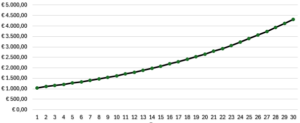
- Keep in mind; below chart is what a 30 year, 5% per annum interest, loan of 1.000 euro looks like with compounding interest, the end amount is over four times the original 1.000.:
*Having those assets means that the author does not really need a loan, but cost wise it can be beneficial to loan, or depending on the situation, it can be preferred. Just an example; it takes a few days for the sale of an exchange traded asset to be fully completed, during which you cannot always access the proceeds, or have to pay interest over what you withdraw. The paid interest can be equal to what you pay over a loan, so financially speaking, you actually loose potential investment profits when selling assets, in some cases. Naturally this is a consideration to be made separately for each case.